

The drawdown table every trader should memorise
Losses compound against you faster than gains compound for you. The arithmetic of recovery is unforgiving, and it is the strongest argument for small risk.
A drawdown is the fall in your account from its highest point. It is the number that ends trading careers, and it does so through a piece of arithmetic that surprises almost everyone the first time they see it: the gain you need to recover is always larger than the loss you suffered.
The table
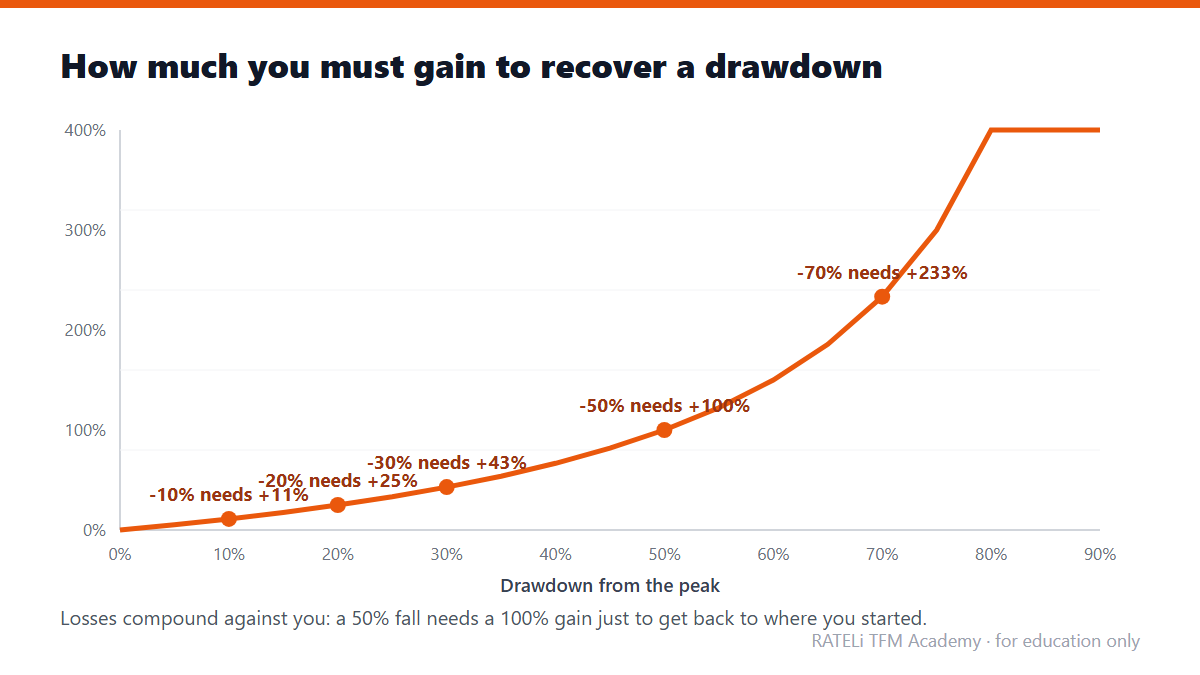
- A 10% drawdown needs an 11% gain to recover.
- A 20% drawdown needs 25%.
- A 30% drawdown needs 43%.
- A 50% drawdown needs 100%.
- A 70% drawdown needs 233%.
The reason is simple. Gains and losses are percentages of a changing number. Lose half of $1,000 and you have $500. A 50% gain on $500 only brings you back to $750. You need to double the $500 to reach $1,000 again.
The curve is not a straight line
Look at the shape of the chart. Up to about 20%, recovery is uncomfortable but realistic. Beyond 30%, the required gain starts to climb steeply. Beyond 50%, it becomes the kind of return that professional fund managers would be proud of in a year, and you would need it simply to get back to where you started.
The goal of risk management is to keep you on the flat part of this curve.
What it means for risk per trade
A run of losing trades is not unusual; it is certain, given enough trades. If you risk 10% per trade, five losses in a row take you to roughly a 41% drawdown. If you risk 1%, the same five losses take you to about 5%. The trades and the setups are identical. Only the size is different, and the size decides whether you are recovering from an inconvenience or from a disaster.
Psychological drawdown
There is a second cost the table does not show. Deep drawdowns change behaviour. Traders who are down 40% often start taking larger risks to "get it back", which is exactly what turns a 40% drawdown into an 80% one. Small drawdowns keep your decision-making intact.
A rule worth writing down
Many disciplined traders use a maximum drawdown limit: if the account falls, say, 10% from its peak, they stop trading live, return to the simulator, and review the journal before continuing. It is not a punishment. It is a circuit breaker that stops a bad patch becoming a permanent one.
Practise it
In the academy simulator, look at your account's peak balance and its lowest point since. Calculate your maximum drawdown, then look up in the table what gain it would have needed. If the answer makes you uncomfortable, that is the table doing its job.