

Why your win rate is telling you almost nothing
A 90% win rate can lose money and a 35% win rate can be excellent. Expectancy, not the win rate, is the figure that decides whether a method works.
"I win most of my trades" is the most common sentence new traders use to describe a method. It sounds like evidence. It is almost meaningless on its own, because it says nothing about how much is won when you are right and how much is lost when you are wrong.
Two traders
Trader A wins 90% of the time, but takes profits quickly at about $10 and lets losers run to about $200. Trader B wins only 35% of the time, but cuts losers at about $100 and lets winners reach about $300.
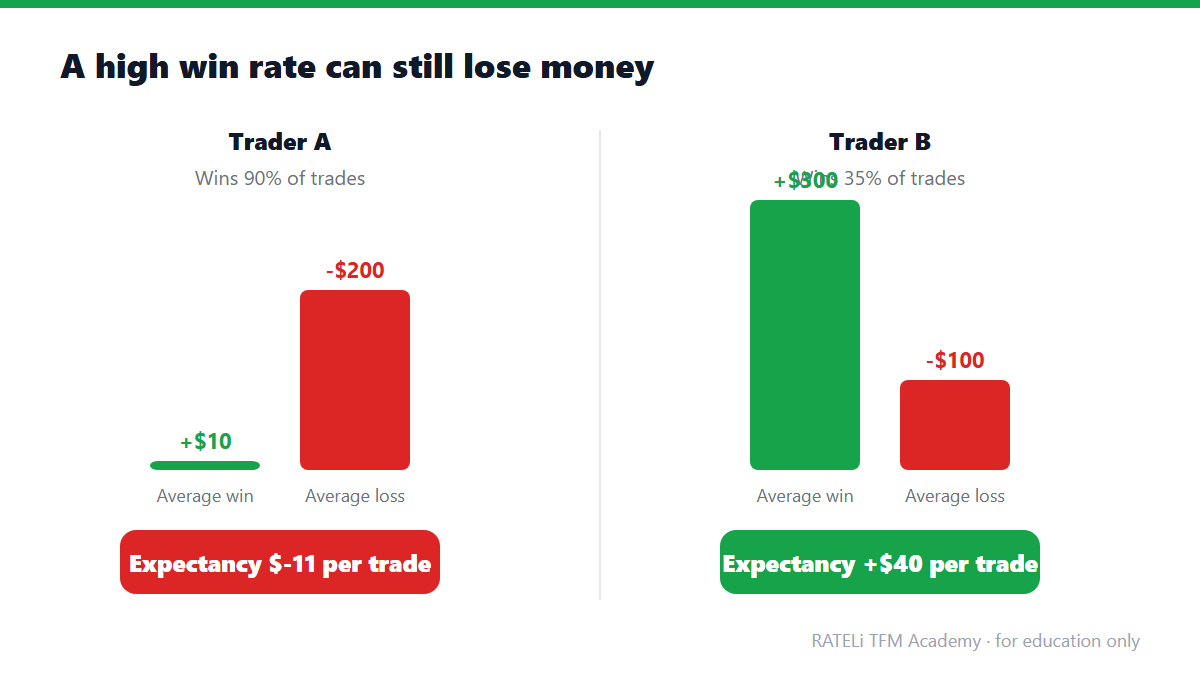
Trader A feels successful almost every day and slowly loses money. Trader B feels like a failure most days and steadily makes money. The difference is not luck. It is arithmetic.
Expectancy
Expectancy is the average amount you can expect to make or lose per trade over a large number of trades:
(win rate × average win) − (loss rate × average loss)
For Trader A: (0.90 × 10) − (0.10 × 200) = 9 − 20 = −$11 per trade.
For Trader B: (0.35 × 300) − (0.65 × 100) = 105 − 65 = +$40 per trade.
A positive expectancy means the method makes money on average. A negative one means it loses money on average, however good it feels.
Why high win rates seduce us
Being right feels good, and being wrong feels like a personal failure. So traders drift toward behaviour that maximises the number of wins: taking small profits early, and holding losers in the hope they come back. Both habits push the win rate up and the expectancy down. Psychology and arithmetic are pulling in opposite directions, and arithmetic always wins in the end.
You do not get paid for being right. You get paid for being right by more than you are wrong.
Measure it in R
The cleanest way to track expectancy is in R, where 1R is the amount you risked on the trade. A trade that hits its stop is −1R. A trade that makes twice what you risked is +2R. Measuring in R removes the effect of account size and lets you compare a month with a $500 account to a month with a $5,000 account.
If your last fifty trades average +0.3R, the method has a positive edge in the conditions you traded. If they average −0.2R, it does not, however many of them were winners.
How many trades do you need?
Ten trades tell you almost nothing; randomness dominates. Thirty start to show a shape. Fifty to a hundred, all taken by the same written rules, begin to be evidence. This is why the academy asks students to journal every simulated trade: you cannot calculate expectancy from memory, because memory keeps the wins and edits the losses.
Practise it
Open your trading journal and add two columns: R at risk and R result. After twenty trades, calculate your expectancy. Then ask the useful question, not "how often am I right?" but "when I am wrong, am I wrong small?"