

Position sizing is the only calculation you must never skip
Size follows from the stop and the risk percentage. Every other order is the wrong way round. Here is the calculation, worked through, and the mistakes it prevents.
Most new traders decide how big a position to take first, and then decide where the stop goes, if they set one at all. That order is backwards, and it is the single most common reason small accounts disappear. Position sizing puts the decisions in the right order: first where you are wrong, then how much you can afford to lose if you are, and only then how big the trade is.
The calculation
There are four inputs, and you know all of them before you place the trade:
- Account size: the money in the account today, not the money you started with.
- Risk per trade: a fixed percentage, usually 0.5% to 1% while you are learning.
- Stop distance: how far, in pips, from your entry to the price that proves your idea wrong.
- Pip value: what one pip is worth for one lot of the instrument you are trading.
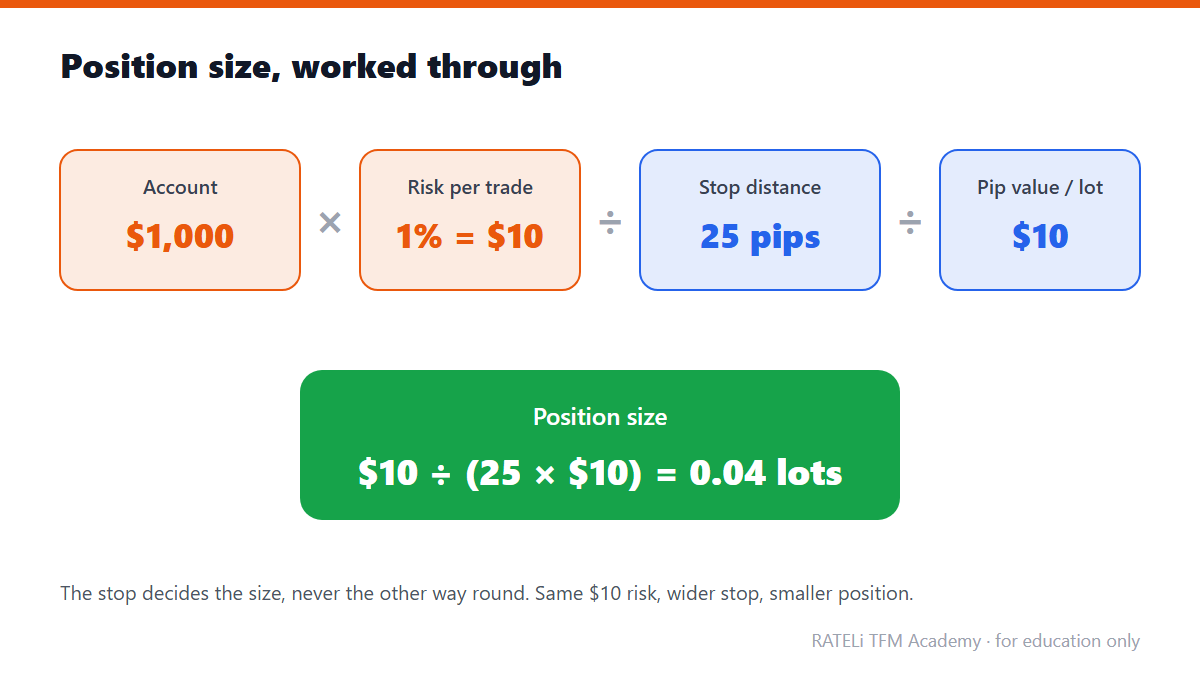
With a $1,000 account and 1% risk, you can lose $10 on this trade. If the stop is 25 pips away and one standard lot of EUR/USD is worth about $10 per pip, then one lot would lose $250 at the stop. To lose only $10 you need 10 ÷ 250 = 0.04 lots.
Why the stop comes first
The stop is not a number you choose to make the position bigger. It is the price where your reason for taking the trade stops being true: below the higher low you are buying from, for example. If that level is 40 pips away, it is 40 pips away; moving it to 15 pips so you can trade a bigger size does not make the trade safer. It only makes it more likely that normal movement stops you out.
When the correct stop is wide, the position becomes small. When the correct stop is tight, the position can be larger. Your risk in money stays the same either way. That is the whole point.
The mistakes it prevents
- Trading the same lot size every time. A fixed 0.1 lots risks $50 with a 50-pip stop and $200 with a 200-pip stop. Your risk swings wildly without you deciding it.
- Risking more after a loss. Size comes from today's balance. After a loss, the same 1% is a smaller amount, which is exactly what protects you during a bad run.
- Ignoring the instrument. Gold, indices and currency pairs quoted in yen all have different pip values. The calculator must use the right one.
If you do not know how much you will lose when the stop is hit, you are not ready to place the trade.
Use the tools, but understand them
The academy's position size calculator does this arithmetic instantly, including pip values for different pairs and account currencies. Use it, every time. But work at least ten examples by hand first, so that you can tell when a number looks wrong. A calculator that has been given the wrong stop distance will confidently give you the wrong size.
A habit, not a calculation
The real skill is not the division. It is the discipline of doing it before every single trade, including the ones you feel sure about. The trades you feel sure about are precisely the ones where traders are tempted to size up, and they are not more likely to win.