

Leverage and margin, without the mystery
Leverage lets a small deposit control a large position. It does not change your risk per pip, your position size does. Here is how margin works and why it catches beginners out.
Leverage is the feature of forex trading that most attracts beginners and most often ruins them. It is not complicated, but it is widely misunderstood, and the misunderstanding is expensive.
What leverage is
Leverage lets you control a position larger than the money you put down. At 1:50 leverage, every $1 of margin controls $50 of currency. To open a position worth $10,000 you need only $200 of margin in your account.
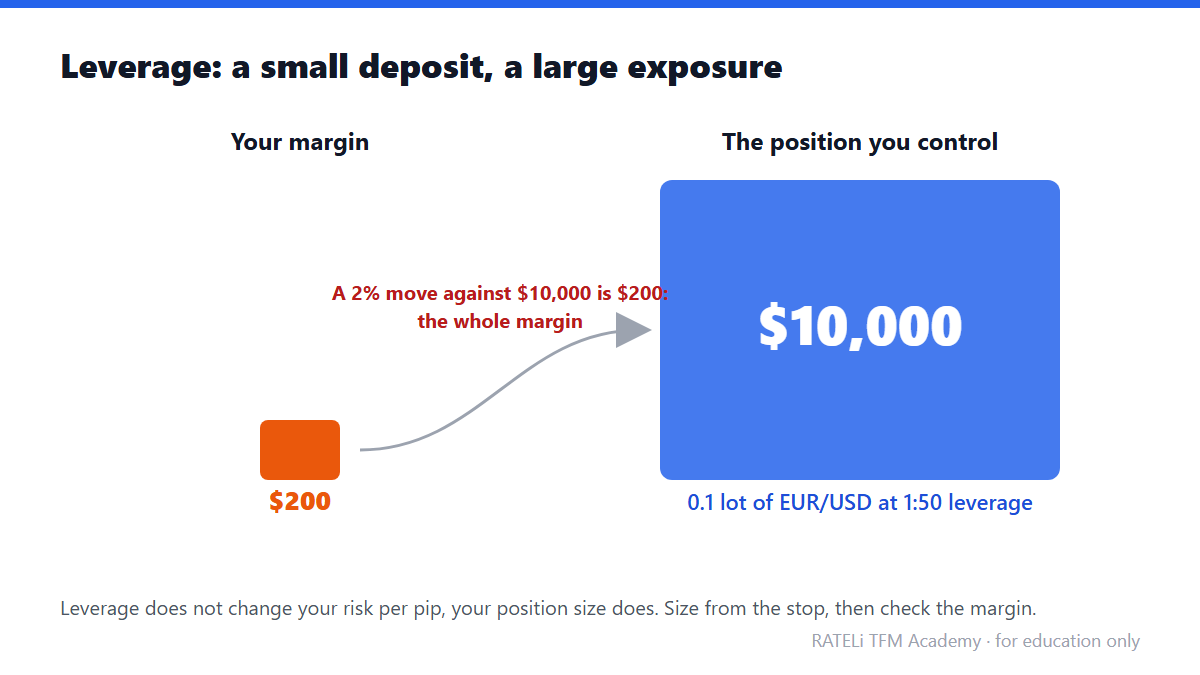
Margin is the deposit your broker sets aside while the trade is open. It is not a fee, and it is not the most you can lose. It is simply collateral.
The misunderstanding
Many beginners believe higher leverage means higher risk. That is not quite right. Your risk on a trade is set by your position size and your stop distance. A 0.1-lot EUR/USD trade with a 20-pip stop risks about $20 whether the account offers 1:30 or 1:500 leverage.
What leverage changes is how large a position you are allowed to open relative to your account. High leverage removes the brakes. It lets you open positions so large that an ordinary move wipes out the account.
Leverage does not decide your risk. It decides how much risk you are allowed to take by mistake.
How an account is wiped out
Take a $200 account at 1:50. The trader opens the largest position the margin allows: $10,000, or about 0.1 lots. A 2% move against a $10,000 position is $200, the entire account. On EUR/USD a 2% move is roughly 200 pips, which happens regularly over a few days. Without a stop, the account is gone.
With proper position sizing, the same trader risking 1% would lose $2 at the stop. The leverage was identical. The outcome was not.
Margin calls and stop outs
As a trade moves against you, your free margin, the money not tied up in open trades, shrinks. If it falls far enough, the broker may issue a margin call and then automatically close positions, called a stop out, usually at the worst possible moment. Traders who size correctly almost never meet a margin call, because their stops close losing trades long before margin becomes a problem.
Rules that keep leverage harmless
- Size every trade from the stop and your risk percentage, never from available margin.
- Treat the leverage your broker offers as a ceiling you will not approach, not a target.
- Keep your total risk across all open trades within a limit, for example 3% of the account.
Practise it
In the academy simulator, open two trades on the same pair with the same stop: one sized correctly at 1% risk, and one sized to use most of the available margin. Watch how each reacts to a normal day's movement. Feeling the difference in a practice account is much cheaper than learning it with real money.