

A trading plan you will actually follow
A trading plan is only useful if it is short enough to follow under pressure. Here is a one-page plan, what belongs in it, and why rules you have not written down bend.

Almost every trader agrees that a trading plan is important, and very few have one written down. The usual reason is that plans become long documents full of good intentions that nobody reads in the moment a trade goes wrong. The plan that works is the one short enough to follow.
One page
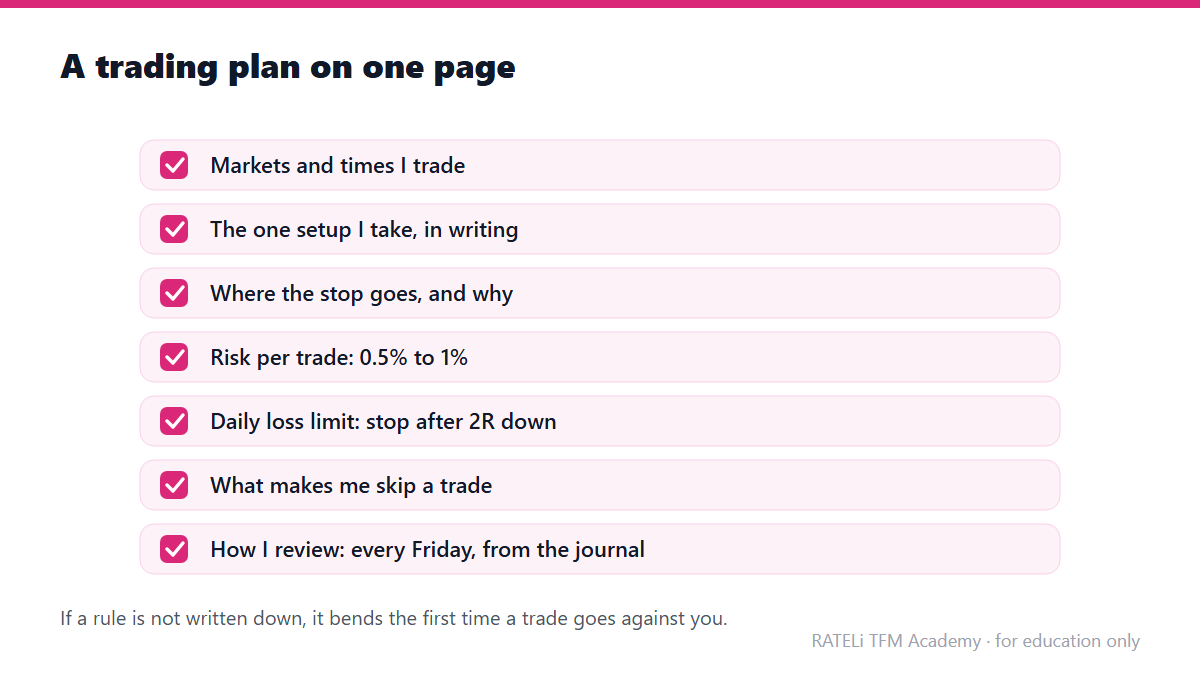
A useful plan answers seven questions, each in a sentence or two:
- What do I trade, and when? The instruments and the hours, nothing else.
- What is my setup? The one pattern you take, described precisely enough that someone else could recognise it.
- Where does the stop go? And why there: the price that proves the idea wrong.
- How much do I risk? A fixed percentage per trade, usually 0.5% to 1% while learning.
- When do I stop for the day? For example, after losing 2R, or after three trades.
- What makes me skip a trade? News, a spread above a limit, a setup that is "almost" right.
- How do I review? When, and from what records.
Why one setup
New traders often collect setups: a breakout here, a reversal pattern there, an indicator crossover from a video. The result is a method that cannot be measured, because every trade is a different experiment. Start with one setup. Take it fifty times in the simulator. Measure its expectancy. Only then consider adding a second.
A rule that is not written down bends the first time a trade goes against you.
The rules you most need are the ones you dislike
Most traders happily write down entry rules. The rules they resist are the ones that stop them trading: the daily loss limit, the news filter, the "skip it if it is almost right" rule. Those are precisely the rules that protect the account on bad days, because bad days are when judgement is weakest.
Before, during and after
- Before the trade, check it against the plan. If it does not fit every rule, it is not a trade.
- During the trade, the plan has already decided the stop and the target. Your job is to leave them alone unless the plan says otherwise.
- After the trade, journal whether you followed the plan.
Review and revise, slowly
A plan is a living document, but it should change slowly and deliberately, not after every loss. Review it once a month using your journal. Change one thing at a time, and only when the evidence from many trades supports it.
Practise it
Write your plan today, on one page, using the seven questions above. Print it or keep it open beside your platform. For your next twenty simulated trades, tick each rule before entering. The academy's mentors review students' plans in live sessions, and the most common feedback is not that a plan is wrong, but that it was not followed.