

Risk to reward: what the ratio really tells you
A 1:2 risk to reward ratio sounds like an edge. It is only a requirement: it tells you what win rate you need, and it is only real if price can actually reach the target.
"Always trade at 1:2 or better" is advice almost every new trader hears. It is useful, but it is often misunderstood. A risk to reward ratio is not an edge on its own; it is a statement about what your win rate must be for the method to make money.
The ratio
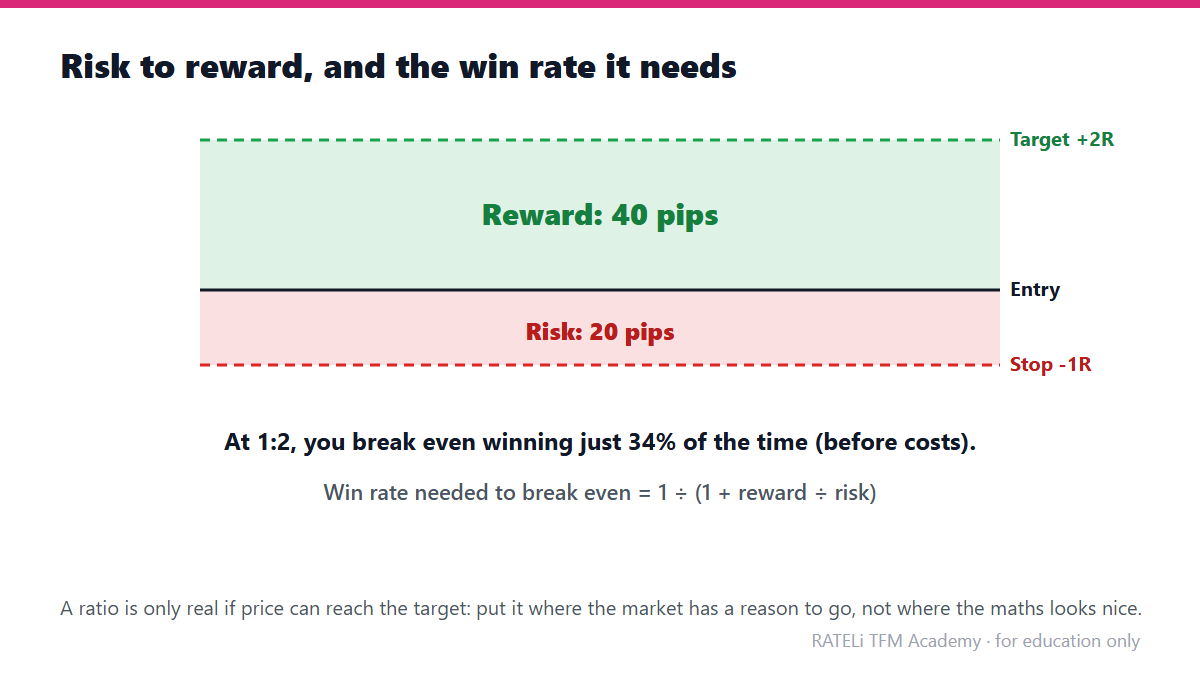
Risk is the distance from entry to stop. Reward is the distance from entry to target. If you risk 20 pips to make 40, the ratio is 1:2. In R terms, the stop is −1R and the target is +2R.
The break-even win rate
Every ratio implies a minimum win rate needed to break even, before costs:
break-even win rate = 1 ÷ (1 + reward ÷ risk)
- At 1:1 you need to win 50% of the time.
- At 1:2 you need 34%.
- At 1:3 you need 25%.
This is why traders love large ratios: they lower the win rate you need. But the formula hides a trap.
Targets that price never reaches
A larger target is harder to reach. If you widen every target from 2R to 5R, your required win rate falls to about 17%, but your actual win rate will fall too, perhaps much further. The ratio improves on paper while the method gets worse in reality.
A ratio is only real if the market has a reason to reach the target.
A good target sits where price has a reason to go: the next significant swing high, a previous area of supply, the boundary of a range. A target placed at exactly 2R because the rule says 2R, with a major resistance level halfway there, is a wish.
Costs move the line
Spreads and commissions are paid on every trade, winning or losing. On short-term trades with tight stops, they can be a large fraction of the risk. A 1:2 trade with a 10-pip stop and a 2-pip spread is really closer to 1:1.6 once costs are included, and the break-even win rate rises accordingly.
Using the ratio properly
- Find the stop first, from structure: where is the idea proven wrong?
- Find the target from structure: where does price have a reason to go?
- Then calculate the ratio. If it is below your minimum, skip the trade. Do not move the stop closer to make the number look better.
That last point matters. Squeezing the stop to improve the ratio is the most common way traders turn a reasonable trade into one that is stopped out by normal movement.
Practise it
Take your last twenty journal entries and record, for each, the planned ratio and the ratio actually achieved. Then calculate your real win rate. Compare it with the break-even win rate for your typical ratio. That comparison, not the ratio alone, tells you whether your method has an edge.