

Reading a forex quote: bid, ask, spread and pips
Before structure, before strategy, you need to read a quote. What the bid and ask mean, why the spread is a cost, and how pips and lots turn price into money.
Every forex trade begins with a quote, and every quote contains more information than most beginners realise. If you understand what you are looking at, many of the costs and surprises of trading stop being mysterious.
A currency pair is a ratio
EUR/USD at 1.0842 means one euro costs 1.0842 US dollars. The first currency is the base; the second is the quote currency. Buying EUR/USD means buying euros and paying in dollars, expecting the euro to rise against the dollar. Selling it means the opposite.
Two prices, not one
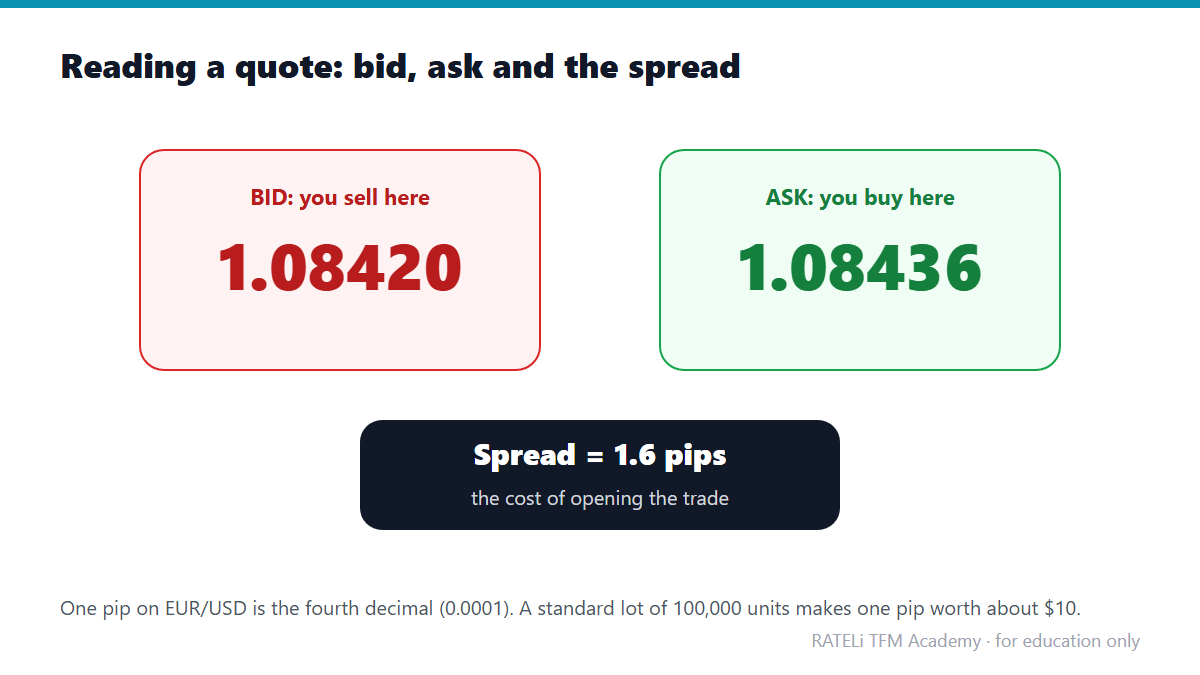
A live quote always has two prices. The bid is the price at which you can sell. The ask is the price at which you can buy. The ask is always slightly higher than the bid, and the gap between them is the spread.
When you open a buy trade at the ask and immediately closed it at the bid, you would lose the spread. That is why every new trade starts slightly negative: the spread is the cost of entering, paid to the broker or the liquidity provider.
Spreads change
Spreads are usually tightest when markets are busiest, for example during the overlap of the London and New York sessions, and widest when they are quiet or nervous: around major news releases, late on Friday, or in the hours after the weekly open. A strategy that looks profitable on a chart can become unprofitable once realistic spreads are included. Always check the spread before entering.
Pips
A pip is the standard unit of price movement. For most pairs it is the fourth decimal place, 0.0001. For pairs quoted in Japanese yen, such as USD/JPY, it is the second decimal place, 0.01. Many platforms show a fifth decimal, called a pipette, which is a tenth of a pip.
If EUR/USD moves from 1.0842 to 1.0867, it has moved 25 pips.
Lots turn pips into money
Trade size is measured in lots:
- A standard lot is 100,000 units of the base currency.
- A mini lot is 10,000 units (0.1 lots).
- A micro lot is 1,000 units (0.01 lots).
On EUR/USD, one pip is worth about $10 for a standard lot, $1 for a mini lot and $0.10 for a micro lot. So a 25-pip move is $250 on one lot and $2.50 on 0.01 lots. The same chart can therefore represent a tiny risk or a dangerous one. Only the position size decides which.
Price tells you what the market did. Position size tells you what it did to you.
Practise it
Open the academy's pip calculator and work out the pip value for three pairs you are interested in, at 0.01, 0.1 and 1 lot. Then open the simulator and note the spread on each pair at different times of the day. These two numbers, pip value and spread, are the quiet foundations underneath every strategy you will ever use.