

Journalling: the habit that separates practice from repetition
Practising without recording is repetition. The journal is where the learning happens, and the entries that matter record decisions and state of mind, not only profit.
Two students can take the same two hundred simulated trades and finish in very different places. One has become a better trader; the other has simply become more practised at the same mistakes. The difference is almost always the journal.
Repetition is not practice
Repetition is doing the same thing many times. Practice is doing something, observing the result, and adjusting. Without a record, you cannot observe honestly, because memory is selective: it keeps the brilliant trades and the painful ones, and quietly forgets the ordinary middle where most of the useful information lives.
What an entry should contain
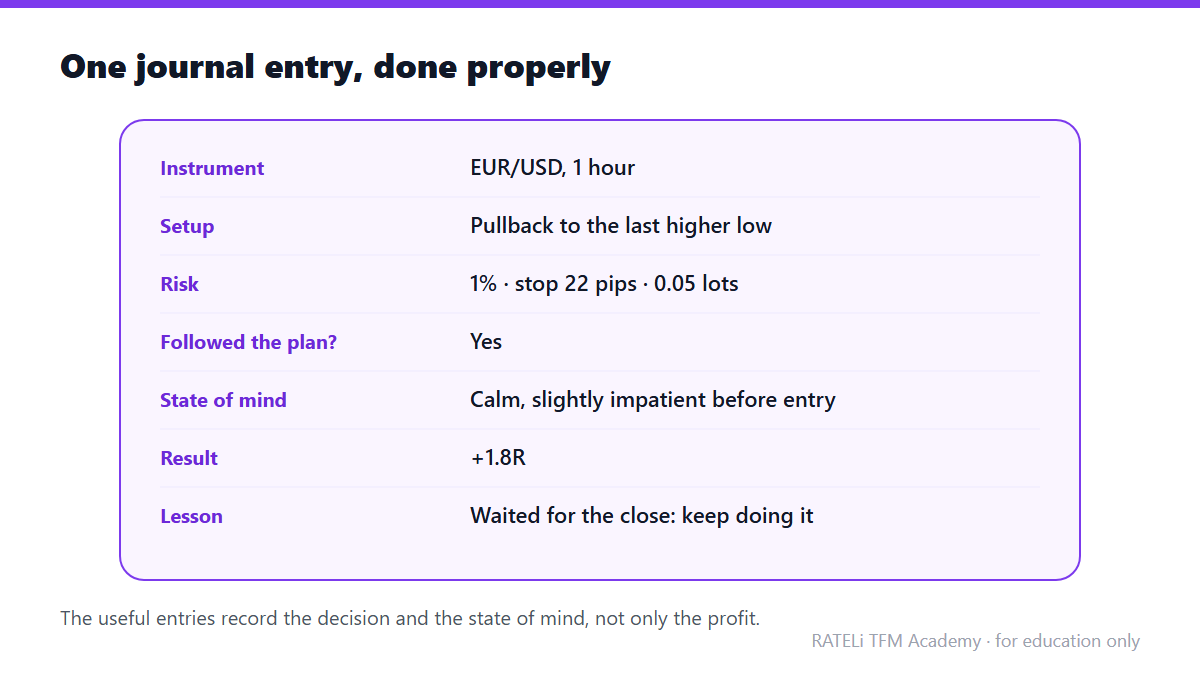
- The setup: which of your written setups this was, in your own words.
- The risk: the stop distance, the position size and the percentage of the account at risk.
- Whether you followed the plan: yes or no. This is the most important field in the journal.
- Your state of mind: calm, rushed, bored, frustrated, overconfident. One word is enough.
- The result in R, not only in money.
- One lesson: a sentence you would want to read before your next trade.
A losing trade that followed the plan is a good trade. A winning trade that broke the plan is a warning.
Why "followed the plan" matters most
Profit and loss mix two things together: the quality of your method and the randomness of the market. Plan adherence isolates the part you control. If your followed-the-plan trades are profitable on average and your broken-plan trades are not, you have learned something precise: your method works, your discipline is the problem. That is a solvable problem.
The weekly review
Once a week, read the week's entries in one sitting. Look for patterns, not individual trades:
- Do your losses cluster at a particular time of day?
- Is a particular state of mind ("frustrated", "bored") followed by rule-breaking?
- Are you moving stops, or closing winners early?
The academy's journal analytics do some of this automatically, showing your results by setup, by emotional state and by whether you followed your risk rule. Use them, but also read the words. The words often tell you what the numbers cannot.
Make it small enough to keep doing
A journal you abandon after a week teaches nothing. Keep each entry to two minutes. Write it immediately after the trade closes, while the reasons are still fresh and before the outcome rewrites your memory of why you took it.
Practise it
For your next twenty simulated trades, write a journal entry for every one, without exception. At the end, count how many followed your plan. Most students are surprised by the answer, and that surprise is the beginning of real improvement.