

Surviving a losing streak
Every trader meets a run of losses, however good the method. Here is how risk per trade decides what a streak costs, and how to stay disciplined while it lasts.

If you trade long enough, you will have a run of losing trades that feels impossible. Ten in a row is not unusual for a method that wins half the time; over a few hundred trades, it is close to certain. The question is not whether a losing streak will come, but what it will cost you and how you will behave while it lasts.
The arithmetic of streaks
A method with a 50% win rate is like tossing a coin. Over two hundred tosses, a run of six or seven tails in a row is normal. For a method that wins 40% of the time, longer losing runs are more likely still. These streaks say nothing about whether the method works; they are what randomness looks like.
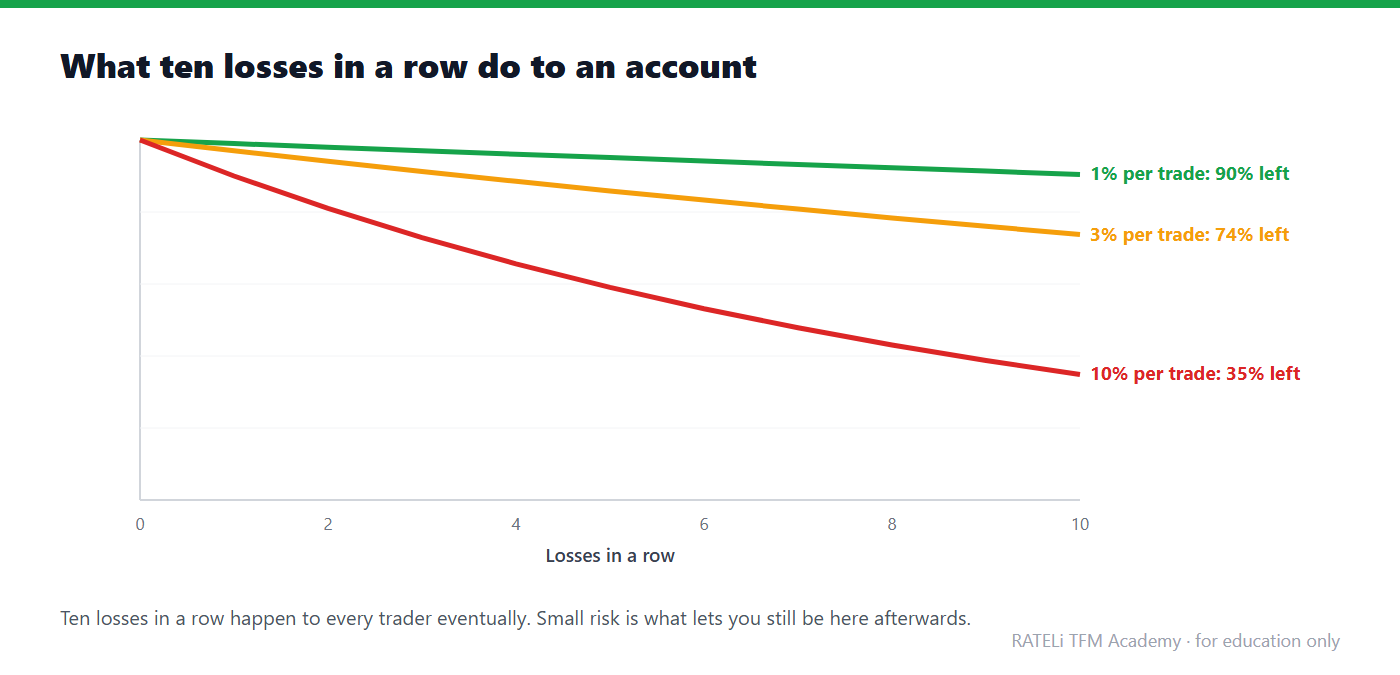
What a streak costs depends entirely on your risk per trade. After ten losses in a row:
- At 1% risk per trade, about 90% of the account is left.
- At 3%, about 74% is left.
- At 10%, about 35% is left.
The trades were the same. The method was the same. Only the size decided whether the streak was a bad fortnight or the end of the account.
Small risk is not timid. It is what lets you still be trading when the streak ends.
What goes wrong emotionally
Losing streaks rarely destroy accounts on their own. The behaviour they provoke does. The common patterns are:
- Increasing size to win the losses back quickly.
- Abandoning the plan for a new method after a few losses, so the next streak begins with an untested approach.
- Revenge trading: taking trades that do not fit the plan because you feel the market owes you one.
- Freezing: skipping valid setups, often just before the method starts working again.
A plan for the streak, written in advance
Decide now, while you are calm, what you will do:
- After a set number of consecutive losses, for example five, reduce risk per trade by half.
- After a set drawdown, for example 10% from the peak, stop live trading and return to the simulator.
- Review the journal: were the losing trades taken according to the plan? If yes, the streak is probably variance. If not, the problem is discipline, not the method.
Look at the right numbers
During a streak, look at your expectancy over the last fifty or hundred trades, not the last ten. Ten trades are dominated by luck. If the longer record is still positive and you followed your rules, the method is likely intact.
Practise it
In your trading plan, add a section titled "When I am losing". Write down your consecutive loss limit, your drawdown limit and the first thing you will do when either is reached. Then trade in the simulator long enough to meet a streak and follow your own instructions. The academy's psychology modules use exactly this exercise, because a plan for losing only proves itself when you are losing.